



Creating a peaceful prayer space at home can help you step away from everyday distractions and spend intentional time with God.
Creating a peaceful prayer space at home can help you step away from daily distractions and spend intentional time in prayer, Scripture and quiet reflection. It does not need to be large, expensive or perfectly decorated; a comfortable chair, a small table or a quiet corner can be enough.
Christians can pray anywhere, and a dedicated space simply supports a consistent devotional routine. This idea is consistent with Jesus’ teaching about praying privately in Matthew 6:6; see the passage on Bible Gateway.
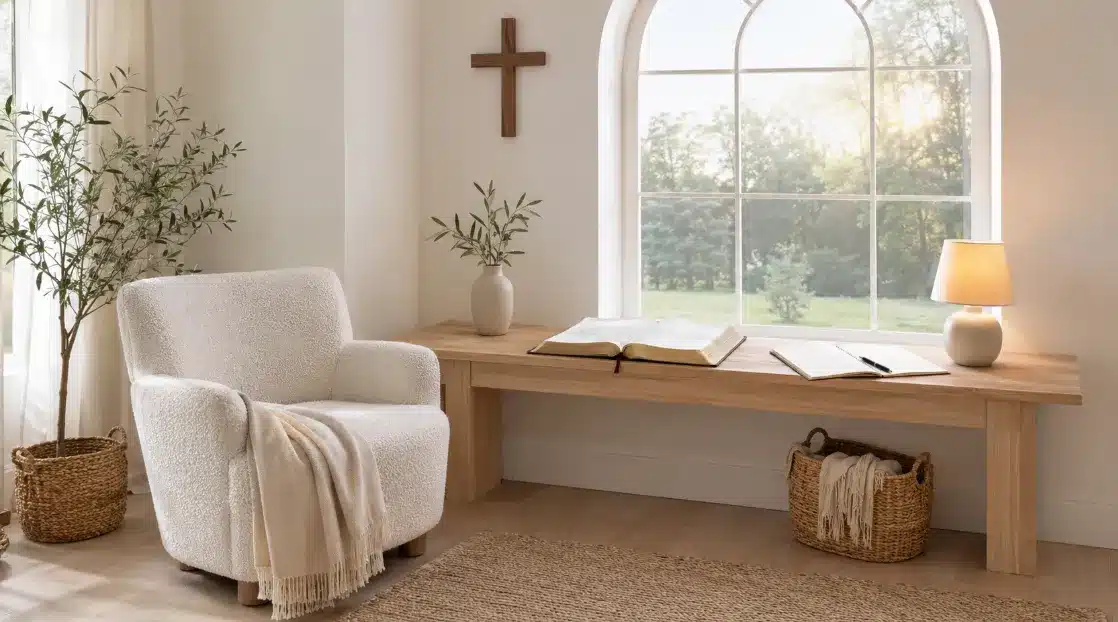
Table of Contents
Why Create a Prayer Space at Home?
Modern life can be busy and distracting. Phones, work, household responsibilities and background noise can make it difficult to slow down and focus.
A designated prayer space can help create a regular rhythm of devotion. Returning to the same place may remind you to pause, pray and spend time reading Scripture.
A home prayer space can be used for:
- Personal prayer
- Bible reading
- Quiet reflection
- Christian journalling
- Listening to worship music
- Family devotion
- Prayer with a friend
- Moments of gratitude
- Seeking wisdom and guidance
The space itself does not make prayer more powerful. Its value comes from helping you become more focused and intentional.
1. Choose a Quiet Location
Begin by looking around your home for a place where interruptions are less likely.
Possible locations include:
- A corner of your bedroom
- A chair beside a window
- Part of a home office
- A quiet area of the living room
- A small table near a bookshelf
- A sheltered section of a conservatory
- A corner beneath a staircase
- A peaceful place in the garden during suitable weather
You do not need an entire room. Even a small corner can become a useful place for prayer.
If you share your home with other people, choose a location that does not interfere with common household activities. You may also explain that you would appreciate a few quiet minutes when using the space.
2. Keep the Area Simple
A peaceful prayer space should help you focus rather than distract you.
Avoid filling it with too many decorations or products. Begin with only a few meaningful items and add others gradually if they genuinely support your devotional time.
A simple space might include:
- A Bible
- A comfortable chair or cushion
- A small table
- A notebook and pen
- Soft lighting
- A cross or another meaningful Christian reminder
You do not need to purchase new furniture. Use items that are already available in your home whenever possible.
3. Make It Comfortable
Comfort can help you remain focused, particularly during Bible reading or longer periods of prayer.
Choose a chair that provides suitable support or place a cushion where you usually sit. Keep the room at a comfortable temperature and make sure there is enough light to read without straining your eyes.
The aim is to feel settled, not so relaxed that you regularly fall asleep.
If kneeling forms part of your prayer tradition, use a comfortable mat or cushion and avoid remaining in a position that causes pain.
4. Include a Bible
A Bible is one of the most useful items to keep in a Christian prayer space. Prayer and Scripture can work together by helping believers reflect on God’s character, promises and guidance.
You might read:
- A Psalm before beginning prayer
- A short passage from one of the Gospels
- A chapter connected with your current Bible study
- A passage about gratitude, peace or wisdom
- Scripture recommended by your church
Try to understand each passage in its proper context rather than selecting isolated verses only because they appear to promise a desired result.
You may use a printed Bible, an audio Bible or a Bible application. If using a phone or tablet, consider activating “Do Not Disturb” so notifications do not interrupt you.
5. Add a Prayer Journal
A notebook can help organise your thoughts and record what you are learning.
Your prayer journal might contain:
- Prayer requests
- Reasons for gratitude
- Reflections from Bible reading
- Names of people you are praying for
- Questions to explore
- Lessons from sermons
- Prayers that have been answered
- Areas of personal growth
A journal is optional. It should support prayer, not make your devotional time feel like an assignment.
Prayer journals also contain personal information, so store yours somewhere appropriate if other people share your home.
6. Use Gentle Lighting
Lighting has a strong effect on the atmosphere of a room.
Natural daylight can create a bright and welcoming prayer space. In the evening, a warm lamp may feel calmer than harsh overhead lighting.
Candles may also be used in some Christian traditions as reminders of prayer and the light of Christ. However, they are not necessary.
If you use a candle:
- Place it on a stable, heat-resistant surface.
- Keep it away from paper, curtains and fabric.
- Never leave it unattended.
- Extinguish it completely after prayer.
- Use a flameless LED candle when an open flame is unsuitable.
Safety should always come before appearance.
7. Consider Fragrance Carefully
A gentle fragrance may help create a calm atmosphere. Some people choose incense, scented oil or a candle inspired by biblical aromas such as frankincense and myrrh.
Fragrance is completely optional. It does not make a place holier and is not required for God to hear prayer.
If you use incense or another scented product:
- Follow the manufacturer’s instructions.
- Maintain suitable ventilation.
- Keep burning incense in a stable, heat-resistant holder.
- Never leave it unattended.
- Keep it away from children, pets and flammable materials.
- Stop using it if it causes irritation or breathing discomfort.
People with asthma, allergies or sensitivity to fragrance may prefer an unscented prayer space.
8. Reduce Digital Distractions
Phones can provide access to Bible applications, worship music and devotionals, but they can also interrupt prayer.
Before beginning, consider:
- Activating silent mode
- Using “Do Not Disturb”
- Closing social media applications
- Setting a simple timer
- Placing the phone out of reach
- Using a printed Bible instead
You do not need to completely remove technology. Use it intentionally and avoid letting it take over your devotional time.
9. Create a Simple Prayer Routine
A prayer space becomes more helpful when it is used regularly.
Choose a time that fits naturally into your day. This might be:
- Shortly after waking
- Before beginning work
- During a quiet afternoon
- After returning home
- Before going to bed
Start with a realistic amount of time. Ten focused minutes can be more meaningful than planning an hour and repeatedly postponing it.
A simple routine might include:
- Sit quietly for a moment.
- Read a short Bible passage.
- Thank God for specific blessings.
- Pray about your concerns.
- Pray for other people.
- Ask for wisdom and guidance.
- Finish with gratitude.
This is only a suggested structure. Christian prayer does not require a fixed formula.
prayer space at home
10. Personalise the Space Thoughtfully
Your prayer corner should reflect your faith and help you focus on God.
You might include:
- A simple wooden cross
- A framed Bible verse
- Christian artwork
- A small plant
- A meaningful photograph
- A prayer list
- A hymn or devotional book
- An olive branch or another natural element
Choose items because they are meaningful, not because you believe they possess spiritual power.
Avoid overcrowding the space. Leaving some areas clear can make the environment feel calmer and easier to maintain.
Creating a Prayer Space in a Small Home
Limited space does not prevent you from creating a prayer corner.
Try using:
- A small basket containing your Bible and journal
- A portable tray
- A shelf beside your bed
- A folding chair
- A windowsill
- A section of a desk
- A small storage box
A portable prayer basket can be especially helpful. Keep your Bible, notebook and devotional materials inside it, then carry it to whichever quiet area is available.
Creating a Shared Family Prayer Space
A family prayer area can provide a place for shared devotion, but it should remain welcoming rather than forced.
Include materials appropriate for the people using it, such as:
- A family Bible
- A list of prayer requests
- Christian books
- Children’s Bible resources
- A gratitude jar
- Comfortable seating
Encourage each family member to contribute prayer requests or reasons for gratitude. Keep shared prayer age-appropriate and respect personal boundaries.
How to Plan a Prayer Space at Home on a Budget
A meaningful Prayer Space at Home does not require expensive furniture or a complete room makeover. Begin by listing what you already own. A Bible, notebook, supportive chair, small lamp and storage basket may provide everything you need. Reusing household items keeps the project practical and prevents decoration from becoming its main purpose.
Set a modest budget before buying anything for your Prayer Space at Home. Separate essential items from optional additions. Suitable seating and adequate reading light are practical priorities, while artwork, decorative textiles and speciality storage can be added later if they remain useful.
Before purchasing an item, ask whether it will improve comfort, organisation or concentration. If it does not serve one of those purposes, your Prayer Space at Home may be better without it. A simple arrangement is generally easier to maintain and adapt as your devotional habits change.
How to Add Privacy to a Prayer Space at Home
Privacy can be challenging when several people share the same home. If your Prayer Space at Home is located in a common area, choose a time when household activity is normally lower. A regular schedule can also help other family members understand when you would appreciate a few quiet minutes.
A folding screen, curtain, bookshelf or strategically positioned chair can create visual separation without permanent construction. Soft furnishings such as rugs and curtains may reduce echoes, although they will not completely block sound. Headphones can be useful for instrumental worship music, an audio Bible or recorded devotionals when appropriate.
Keep personal journals and written prayer requests in a drawer, closed basket or another suitable location. Privacy is especially important when notes contain information about other people. A respectful Prayer Space at Home should support quiet reflection without disrupting shared routines or exposing personal information.
Make Your Prayer Space at Home Accessible and Comfortable
A Prayer Space at Home should accommodate the physical needs of the person using it. Choose a stable chair with suitable back support and enough room to sit down and stand safely. Keep frequently used materials within comfortable reach so that you do not need to stretch or bend repeatedly.
Good lighting is essential for reading. Position the lamp so that it illuminates the Bible or journal without creating strong glare. Larger-print Bibles, magnifiers, audio Scripture and digital text-size controls can make a Prayer Space at Home more accessible for people with visual difficulties.
Avoid loose cables, unstable tables and objects placed in walking paths. If kneeling is uncomfortable, prayer can be practised while sitting or standing. The value of a Prayer Space at Home does not depend on adopting a particular posture. Comfort and safety allow attention to remain on prayer and Scripture.
How to Keep a Prayer Space at Home Organised
A cluttered area can gradually become distracting, so give every item in your Prayer Space at Home a clear place. A small basket can hold a Bible, journal, pens and devotional book. A drawer or document wallet can protect prayer lists and personal notes.
Spend a few minutes each week returning books, cables and stationery to their proper places. Dust lamps and surfaces, wash frequently used textiles when necessary and remove empty packaging. If incense, anointing oil or candles are stored in the area, follow their product instructions and keep them securely away from heat, children and pets.
Review the contents of your Prayer Space at Home periodically. Remove items that are no longer useful and replace pens, notebooks or reading materials only when needed. Maintaining the area should remain simple. The Prayer Space at Home exists to support devotion rather than create another demanding household task.
Adapt Your Prayer Space at Home as Your Routine Changes
Your schedule, household and devotional practices may change over time. A Prayer Space at Home that works during one season may need adjustments later. Changes in work hours, family routines, mobility or available rooms can affect when and where quiet prayer is practical.
Use a portable basket when a permanent corner is unavailable. It can contain your Bible, journal and other essential materials and be moved to a bedroom, desk, garden or quiet living-room chair. This approach allows a Prayer Space at Home to remain useful in a small or frequently changing household.
Reassess the space every few months. Consider whether the chair remains comfortable, the lighting is adequate and digital distractions are controlled. Make only the changes that genuinely support prayer and Bible reading. An adaptable Prayer Space at Home can continue serving its purpose without depending on perfect decoration or a fixed location.
Common Mistakes to Avoid
Making the space too complicated
You do not need expensive furniture, perfect decorations or a large collection of devotional products.
Focusing more on appearance than prayer
A beautiful space can still become distracting. Its purpose is to support devotion, not to become a display.
Treating objects as spiritually powerful
A cross, candle, oil or incense can carry symbolic meaning, but Christian trust should remain in God.
Comparing your space with social media
Your prayer space does not need to resemble an interior-design photograph. It only needs to be suitable for your home and devotional habits.
Believing you can only pray there
A prayer corner is a helpful resource, not a limitation. Christians can pray at home, at church, outdoors, while travelling or wherever prayer is needed.
Frequently Asked Questions
Do I need a separate room for prayer?
No. A quiet chair, a small corner or a portable basket containing your devotional materials can be enough.
What should I place in a Christian prayer corner?
A Bible, notebook, pen and comfortable seat provide a useful starting point. Other items, such as a cross, lamp or devotional book, are optional.
Does a prayer space need anointing oil or incense?
No. These products are optional and depend on personal conviction and church tradition. God does not require a particular object or fragrance before Christians can pray.
Can I use my bedroom as a prayer space?
Yes. Choose a calm corner and try to keep it uncluttered. A small chair, bedside table or cushion may be sufficient.
How can I keep the space peaceful?
Remove unnecessary clutter, reduce digital distractions, use comfortable lighting and ask others in your home to respect your quiet time when possible.
How often should I use my prayer space?
There is no required schedule. Choose a regular and realistic routine that supports sincere prayer without turning it into a burden.
Begin With What You Have
A peaceful prayer space does not depend on size, expense or decoration. Begin with the space and materials already available to you.
Choose a quiet place, keep it comfortable and use it consistently for prayer, Scripture and reflection. Over time, it can become a familiar reminder to pause and direct your attention towards God.
Explore the Nimots collections of Christian books and spiritual resources, incense and anointing oils for your devotional setting.
You may also find these guides helpful:
- What Is Anointing Oil? Biblical Meaning and Christian Use
- How to Use Anointing Oil for Prayer: A Christian Guide
- Frankincense and Myrrh in the Bible: Meaning and Uses
This article is provided for educational and devotional purposes. Products and decorative objects are optional and should always be used according to their safety instructions.


